The Teambuilding Cycle: A 5-stage framework used to improve collaboration
Emy Mylona
February 16, 2026
There was a time when Emy Mylona believed that effective teamwork happened naturally. Teams were formed, people showed up, and collaboration would follow. Then came an experience that would reshape everything she thought she knew about building high-performing teams.
As a volunteer with the European Youth Parliament, a network that simulated the work of the European Parliament, Emy watched something remarkable unfold. High school and unversity students would arrive as strangers, form committees, and prepare to debate serious matters over three or four-day conferences. But before any of that happened, they experienced something unexpected: a full day of teambuilding.
"It was amazing to see that through what seemed at the time silly games, groups of strangers were turning into close-knit, well-functioning groups who were able to collaborate and exchange opinions on serious matters as if they knew each other forever," Emy recalls.
Years later, reflecting on that experience, a realization emerged. Those games weren't silly at all. Every activity served a purpose. Every stage was carefully placed at the right moment to ensure that connection was intentionally built before team work happened. The question that followed changed the trajectory of her work: "Could workplaces benefit from this approach and learn from this framework?"
The answer to that question became the Teambuilding Cycle, a framework designed around a principle that most organizations overlook. "This framework is all about showing that effective teamwork and collaboration don't happen just because people find themselves in the same environment and team," Emy says. "It requires intentional efforts to bring people together, to connect, and to foster trust."
At the center of this framework sits something most workplaces treat as an afterthought: play. But placing it at the center wasn't a casual decision. It was a deliberate statement about how learning and connection actually work.
Why play belongs at the center
The typical workplace treats play as a nice-to-have. Perhaps there's a game at the company offsite, squeezed in after the serious work is done. Perhaps there's a team lunch with some light banter. But what if that approach has it backwards?
"I find Play to be integral in this whole cycle because it is a method of learning and connecting that most organizations are unaware of; or they are aware of but they implement it as an afterthought and not as an integral part of the process," Emy explains. "Placing it in the center emphasizes that every exercise, every activity and every intervention should have a playful element ingrained so that we can ensure that learning is fun, engaging, memorable and impactful."
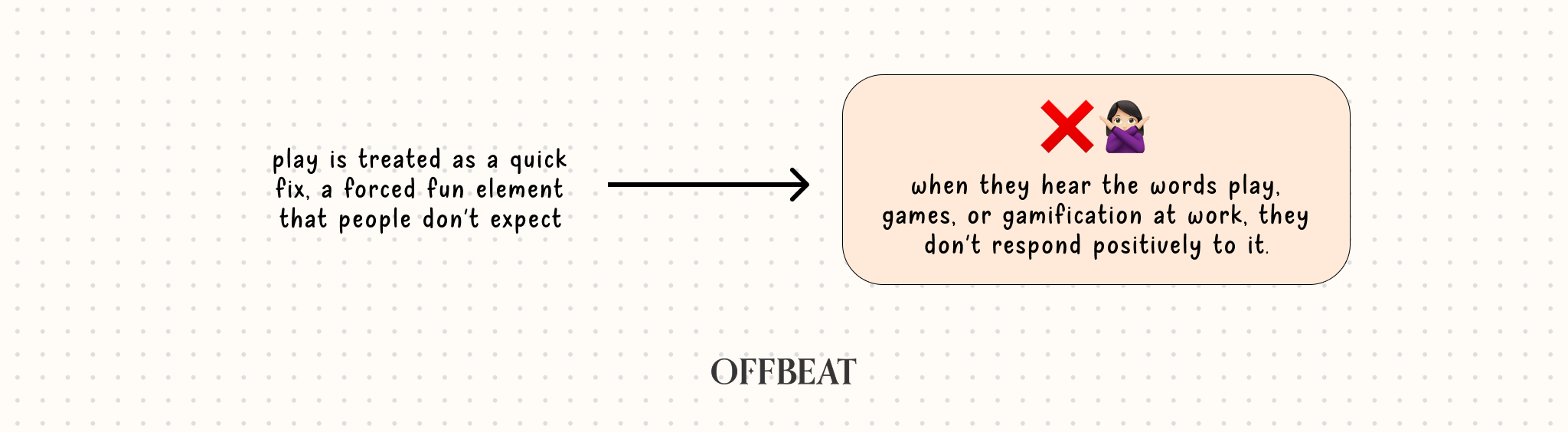
It is true, though, that when people hear the words play, games, or gamification at work, most often than not, they get the 'ick'. Rolled eyes and 'oh here we go again' are reactions Emy has come across with. But why is that? She believes it's because play is treated as a quick fix, a forced fun element which people don't expect so they don't respond positively to it.
That's why Emy advocates that when introducing play at work, it should be gradual and purposeful; not just to say 'we do fun stuff at our offsite'. Fun should be part of a team's culture so that people know that playful elements are part of how the team works. The gradual process can be something extremely simple, like starting a team meeting with music or doing a brainstorming session using role-playing, for example, assign a team member to be the optimist while another is the factual one. Interventions like these prepare the ground for playfulness, and trust me, it makes a difference later on.
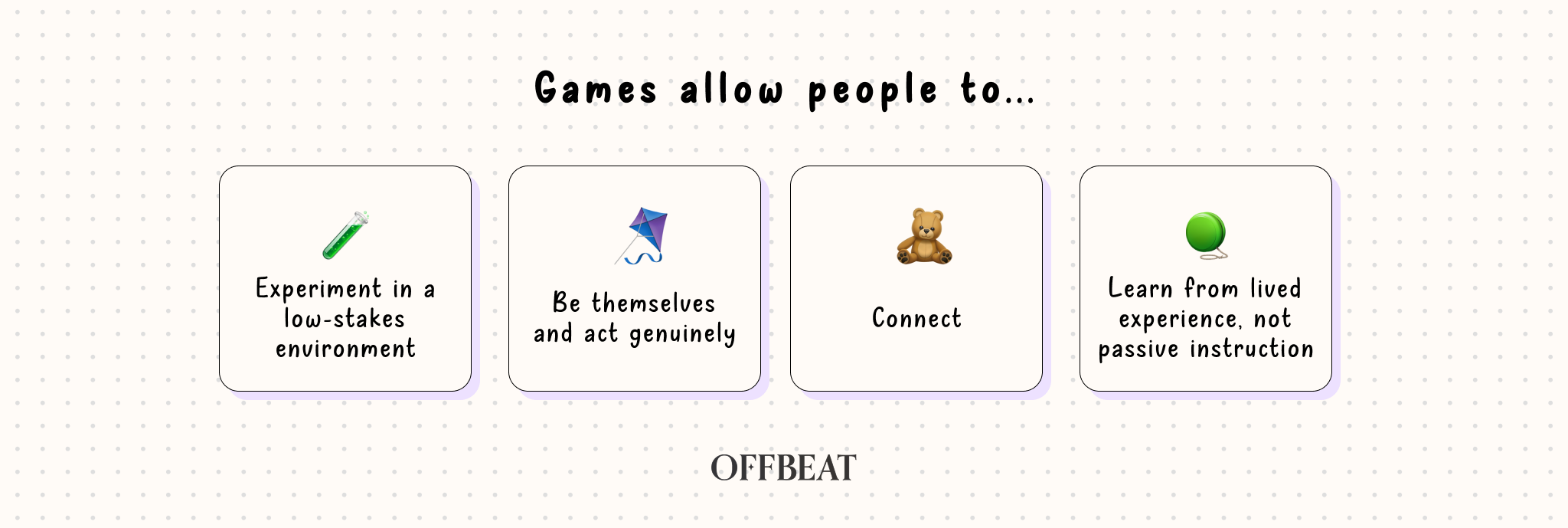
The power of play runs deeper than most leaders realize. In a TEDx talk last year, Emy explored why so few organizations tap into what she calls play's "hidden power." The reason games work so well for team development comes down to something fundamental about human behavior. "Games have so many lessons to teach us because they create a low-stakes environment where we can experiment, be ourselves, and act genuinely, shedding all the masks that we wear every day; the mask of the high-performer, the one of the manager, the one of the geek, and so on," Emy explains.
When people play, something shifts. The carefully constructed professional personas start to fall away. What remains is something more genuine, more open. "This is why when playing we have the best learning environment to foster connection and performance, as we are more open, less reserved, and more genuine," she says.
But the real magic happens in the translation. "When we connect these lessons learnt in this almost sandbox-like environment to something tangible in our day-to-day (work) life, this is when learning becomes more memorable and impactful: because learnings come intrinsically from experience and not from passive instruction," she explains. Learning that comes from lived experience sticks in a way that PowerPoint presentations never will.
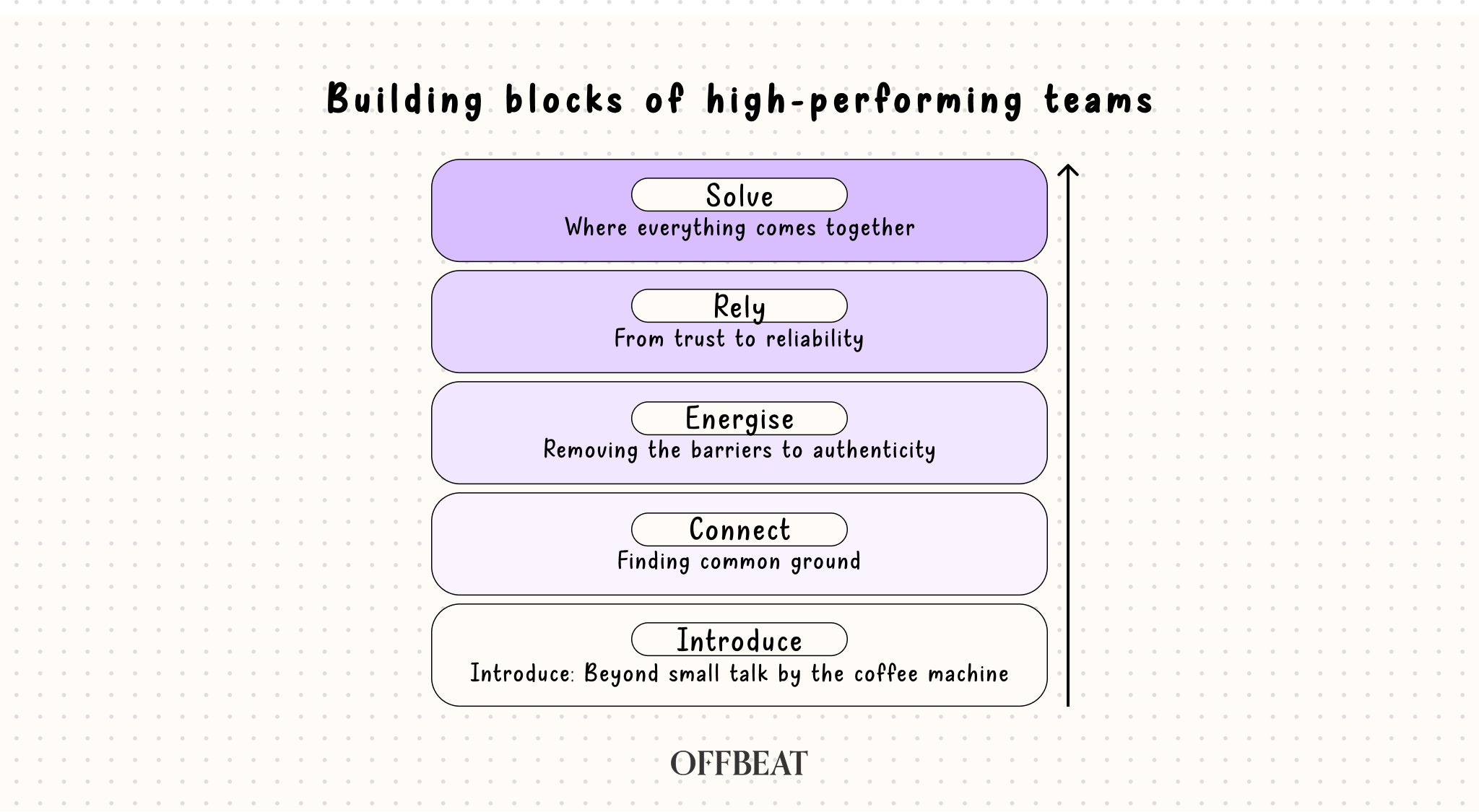
The five stages: Building blocks of high-performing teams
The Teambuilding Cycle unfolds across five distinct stages, each building on the foundation of the one before. Think of it as the journey from strangers to a team that can tackle complex challenges together.
Introduce: Beyond small talk by the coffee machine
It starts with the basics, but not the basics most organizations think about. "It all starts with giving people the opportunities to get to know each other besides the small talk by the coffee machine; building a bond and seeing each other as individuals, not just 'roles,'" Emy explains.
This stage matters especially during onboarding, when there's a dangerous assumption lurkng, that time passing by makes teams grow. Yet, time alone doesn't build teams. Intention does.
L&D teams can facilitate this through gamified elements that make the introduction fun rather than forced. Think onboarding bingo or games where people guess which statements connect with which team member. The goal is simple: help people see each other as humans, not just job titles.
Subscribe to Offbeat
Every Sunday we send over a pack of articles, e-books, podcasts, videos, and thoughts, to inspire you and help you stay up to date with what's happening within our L&D community
Awesome! Now, check your inbox
Oops! Something went wrong while submitting the form.
Connect: Finding common ground
Once introductions are made, the work deepens. "After the initial introduction, we want to deepen the connection and establish common ground by finding similarities and building empathy," Emy explains. This stage is about building what's called knowledge-based trust, the foundation everything else rests on.
Team days and off-sites provide natural opportunities for this stage. The key is facilitating discussions and games that encourage people to open up. "L&D can facilitate this by encouraging discussions and games that allow people to open up and go deeper, e.g., how they like to receive feedback, if they are a morning person, or what irritates them," Emy suggests. These aren't surface-level questions. They're the questions that help people understand how their teammates actually operate.
Energise: Removing the barriers to authenticity
The third stage tackles something that holds many teams back: the fear of being judged. "In this stage, we want to remove anything that keeps us from being our authentic selves," she explains. "Here, we introduce the element of fun, but not just for the sake of having it, but rather as a structured and purposeful way to remove fear of judgment, and dissolve hierarchy and stiff formality."
When facilitated well, this stage creates something powerful. "With L&D's help, people can let loose and create a sense of 'we're all in this together,'" Emy says. "This shared feeling makes it easier to tackle challenges together later on." Activities like team challenges, races, or quests work well here. The goal is to create shared experiences that level the playing field.
Rely: From trust to reliability
Trust is good. Reliability is better. "Here, we want to see the trust that we have built in previous stages deepen into reliability," Emy explains. "If this goes well, we also see resilience being fostered."
Teams with high reliance can handle what many teams can't: handle conflict, navigate setbacks, and find solutions together. The games at this stage involve literal trust: blindly guiding your teammate around the room, for example. It's about learning to let go and put your faith in another person.
Solve: Where everything comes together
The final stage is where all the previous work pays off, because it is where we reach the phase where all the previous levels turn into action, the stage of problem-solving. If the cycle has been followed successfully, the team works smoothly, leveraging the foundation they've built.
-to-By this point, something has shifted in the team's culture. "By now, team members feel empowered to voice new ideas, experiment with unconventional approaches, and challenge the status quo," Emy explains. "All that is because a safe space has been created and is now an integral part of the team's culture."
Activities like the marshmallow challenge or building with Lego structures test how the team works together to overcome obstacles. But the real test is watching how they communicate, support each other, and navigate disagreement.
Binding all five stages together is the process of debriefing. "After important games or between stages, the team discusses what happened, how they felt, what lessons were learned, and how they can use those learnings in their day to day collaboration," Emy mentions. Without this reflection, the games remain just games. With it, they become learning experiences that translate directly to how the team functions.
Why the order matters
These stages aren't arbitrary. They follow a logic that mirrors how human relationships actually form. "These five stages represent the journey of a high-performing team, from almost strangers to collaborating and overcoming challenges," Emy explains. "Each step represents the building blocks that teams need to have at their foundation to be able to have a solid structure."
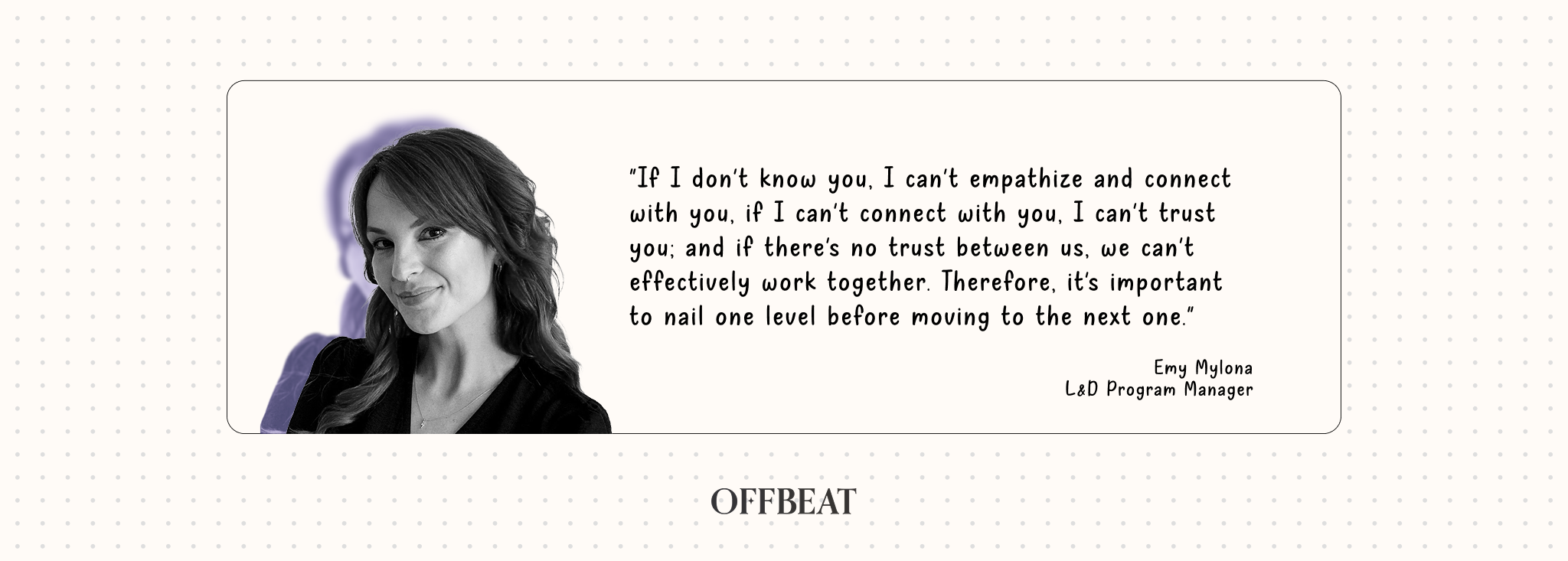
The progression is intuitive once you think about it. "If I don't know you, I can't empathize and connect with you; if I can't connect with you, I can't trust you; and if there's no trust between us, we can't effectively work together. Therefore, it's important to nail one level before moving to the next one."
What happens when facilitators skip or rush through stages? The foundation weakens. "As every stage builds on the previous one, the risk is building weak foundations," Emy cautions. But there's an interesting silver lining. "However, even if this does happen, it's a good opportunity to fail."
Sometimes Emy intentionally pushes teams to their limits to reveal gaps. "Sometimes, I insert games and activities that aim to push the boundaries of a team to uncover these 'pain points' and emphasize the importance of a certain element even more," she explains. "So the good thing is that facilitators can always go back to reinforce a certain stage or spend more time on something before moving on."
Adapting the cycle to reality
The framework isn't meant to be rigid. "The cycle is meant to be adaptable, depending on which stage the team is at," Emy emphasizes. Teams come in different configurations with different histories. Some are newly formed. Others have worked together for years but never connected on a deeper level. Some are missing the trust element entirely.
"Teams can start anywhere, as long as the steps before are also looked after," Emy explains. Her advice for facilitators is practical: "Use a game or activity from each stage to assess where the team is at, even if the team session is focused on a later stage. This will give the facilitator a better 'feel' of the interventions needed."
Knowing when to move forward requires reading the room. "Usually, facilitators will experience that the activities and games played are becoming smoother and easier," she mentions. "It's almost like playing a game, and you have mastered a level, so then you are ready for a more challenging quest."
Emy likes to test teams by introducing variations of the same game. Take a counting game where the group needs to reach twenty with only one person speaking at a time, in no particular order, with no strategizing allowed. "If the group succeeds, I ask them to do it again, but this time faster; and if they can also do that, I ask them to do it again, but this time with their eyes closed," she explains.
This approach draws on researcher Nicole Lazzaro's concept of "Hard Fun," which describes the enjoyment that comes from overcoming difficult challenges. It's about finding that sweet spot where the challenge is just hard enough to be engaging.
The psychological foundation
The framework isn't just based on personal experience. It aligns with established theories about how teams develop and perform. What many organizations miss is the starting point. "What most organizations forget is that building trust begins with getting to know one another. If we look at team psychology models like Lencioni's Trust Pyramid and Tuckman's development stages, we will see the evidence."
Furthermore, the evidence extends beyond those frameworks. "Ideas like psychological safety and social penetration theory show that trust develops only when team members feel at ease, understood, and secure enough to express themselves freely," she explains. The question that follows is pointed: "So how do we expect teams to share feedback, discuss their opinions, and collaborate if they're essentially strangers?"
The hardest stage to facilitate
Ask about the most challenging stage, and the answer might surprise you. "Believe it or not, it's usually the Introduce stage," Emy reveals. The reason comes down to workplace culture and expectations. "I have found people are a bit skeptical or hesitant when it comes to playing games or game based activities at work. So taking that first step and letting go of the 'ick' is the hardest."
-But something shifts once people engage, as resistance wears off and is replaced by curiosity and openness. The initial skepticism gives way to engagement once people experience the value firsthand.
Her favorite stage to design tells a different story. "I love the Solve stage, because it's the moment of truth and the ultimate test," Emy admits. "And also because it often reveals if the team needs more work on the stages before."
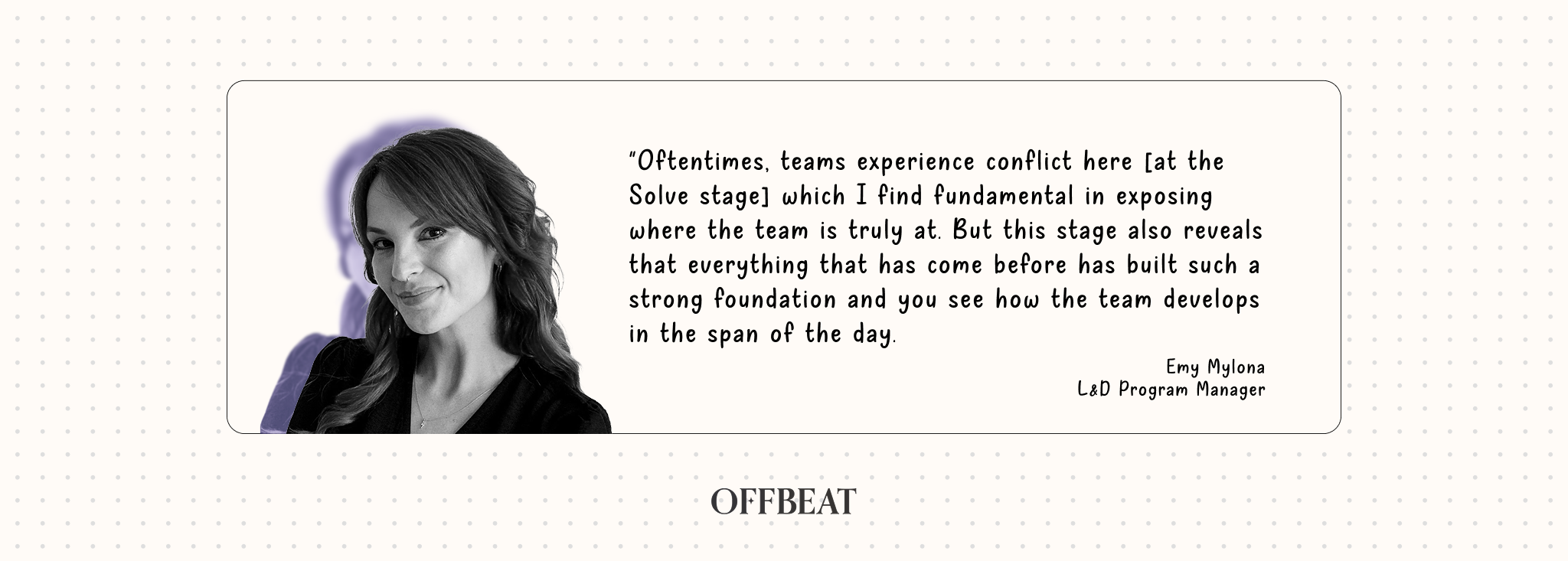
This stage exposes the truth about where a team actually stands. "Oftentimes, teams experience conflict here, which I find fundamental in exposing where the team is truly at," Emy explains. "But this stage also reveals that everything that has come before has built such a strong foundation, and you see how the team develops in the span of the day. So with either outcome, I find this stage to be the most dynamic."
Applying the framework
The framework adapts to different contexts and session types. "It can be used and adapted according to the team's needs," she explains. "The most direct use case is in a team day or a team off-site, but it can also be adapted as part of a company's onboarding process and following the employee lifecycle within their team."
The starting point is always the same: understanding the goal. One team wanted to improve communication around feedback. Another team with members split between Amsterdam and Berlin wanted to build connections.
"So with that in mind, I incorporate activities that lead to that goal and give more weight to the ones that are directly related to it," Emy explains. "However, the cycle is always the same; the difference lies in the kind of interventions and which elements get the most focus."
Evolution and iteration
The framework has evolved over time, though not in the way you might expect. The model itself didn’t change, but the use of it did. "The kind of activities that I use have changed to adapt to the audience, and the way I describe it is also more explicit."
The shift reflects a change in audience. "See, when I was first introduced to the cycle, I was a student in a team with other students. Young people are more open to experience, and what I saw is that we did the activities without really questioning why we do it; it was just fun," Emy recalls.
Working with professional teams requires a different approach. "Now that I brought this cycle to work teams, I need to explain more of the why behind it and to give more context.”
Building your facilitator toolkit
Success with the cycle requires flexibility and preparation. "I would encourage facilitators to build their toolkit of activities for every stage; as the cycle is dynamic, the power of it lies in the flexibility that the facilitator shows when choosing which games and activities the group will play," Emy advises.
Reading the room matters more than sticking rigidly to a plan, and her go-to resources come from unexpected places. "Great resources that have worked for me are games from the educational sector or even from theatre and improv; I have used a lot of them, always with some fine-tuning of course."
The misunderstanding that holds people back
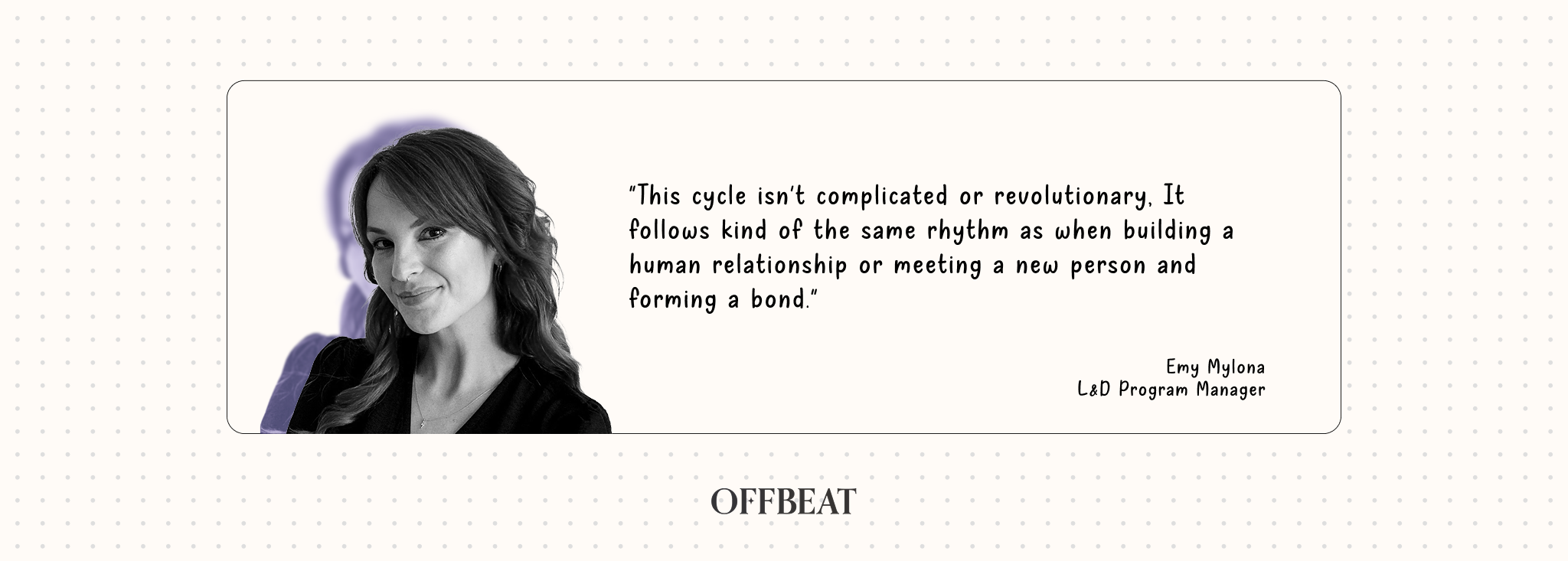
There's one misconception about the framework that deserves clarification. "This cycle isn't complicated or revolutionary," Emy says. "It follows kind of the same rhythm as when building a human relationship or meeting a new person and forming a bond."
The key is naturalness. "It works if it's natural and not forced, and I think this also comes with experience. But once it's there, it's a great tool to build strong teams!"
The simplicity is actually the point. Teams don't need complicated frameworks or revolutionary approaches. They need what humans have always needed to work together effectively: time to know each other, space to build trust, permission to be authentic, and opportunities to rely on one another before tackling hard problems together. The Teambuilding Cycle simply makes that process intentional rather than leaving it to chance.
In a world where remote work, rapid growth, and constant change make it harder than ever to build cohesive teams, this framework offers something valuable. Not a magic solution, but a structured approach grounded in how humans actually connect. Because at the end of the day, high-performing teams aren't built through org charts and strategy documents. They're built through the kind of intentional connection that turns strangers into collaborators who trust each other enough to do their best work.
Emy Mylona
Learning & Development | Facilitator | Speaker
Meet Offbeat
We’re the place where L&D professionals accelerate their career. Live programs, mentorship, lots of practice and knowledge sharing.




.svg)


.png)
.png)
.png)
.png)
